

Chris D. Meletis, N.D.
Neuroinflammation is an inflammatory response that occurs within the brain or spinal cord. Neuroinflammation is a process that can be both pathological and beneficial.1 For example, neuroinflammatory processes are involved in communication between the brain and immune system, and in that case, neuroinflammatory processes are beneficial and adaptive.1 However, most research has focused on the pathological aspects of neuroinflammation and how to protect against the damage.1 Consequently, supporting a healthy inflammatory response in the brain will be the focus of this article, with an emphasis on nutrients that can support cognitive health, especially those found in Tru Acuity from TruGen3®.
Neuroinflammation and Cognitive Health
Research indicates that neuroinflammation is not only a result of cognitive challenges during aging, but rather a key player in their development.2 It has been known since the 1990s that individuals who use nonsteroidal anti-inflammatory drugs (NSAIDs) over the long-term have as much as a 50% reduced risk of developing cognitive decline, supporting the fact there is a relationship between neuroinflammation and poor cognitive health.3
Microglia activation is a key pathway in neuroinflammation and associated cognitive pathologies.4 Microglia are brain cells that regulate brain development, help maintain neuronal networks, and repair damage.5 Microglia are the predominant source of proinflammatory cytokines and thus are important mediators of neuroinflammation.5
Antioxidant Defense: Vitamin E Isomers and Tocotrienols
GammaSource® naturally mixed tocopherols, particularly gamma-tocopherol and alpha-tocopherol, act as potent lipophilic antioxidants that neutralize reactive oxygen species (ROS) and reactive nitrogen species (RNS) and are therefore useful in supporting a healthy inflammatory response in neuronal tissue.6 Unlike alpha-tocopherol alone, gamma-tocopherol exhibits an enhanced ability to scavenge ROS and protect against lipid peroxidation in brain cell membranes, indicating it is more effective in reducing mitochondrial ROS levels while boosting ATP production and complex V enzyme activity.7
TocSource® naturally mixed palm tocotrienols are a structurally distinct form of vitamin E with enhanced penetration into tissues that have saturated fatty layers, particularly the brain and liver.8 Tocotrienols have unique antioxidant and anti-inflammatory properties compared to tocopherols by modulating cyclooxygenase-2 (COX-2). Tocotrienols also inhibit proinflammatory signaling pathways including nuclear factor-kappa B (NF-κB), thereby reducing both oxidative stress and neuroinflammation.8
Omega-3 Fatty Acids: Neuroprotection Through Anti-inflammatory and Membrane-Stabilizing Mechanisms
OmegaChoice® Omega-3 essential fatty acids, particularly docosahexaenoic acid (DHA) and eicosapentaenoic acid (EPA), work with vitamin E compounds to support many aspects of neuroprotection.9 Approximately 35% of brain lipid content is made up of DHA, which supports synaptic plasticity, neurogenesis, and neurotransmission essential for cognitive clarity.10 EPA plays an important role in cerebral blood flow and supports a healthy inflammatory response in the brain, while both EPA and DHA exhibit antioxidant properties that are synergistic to the radical-scavenging properties of tocopherols and tocotrienols.11
The gut-brain axis is a target of omega-3 fatty acids. EPA and DHA enhance intestinal and blood-brain barrier integrity while supporting beneficial microbial populations that promote systemic immunity.11 These fatty acids also play a role in the hypothalamic-pituitary-adrenal (HPA) axis by reducing excessive cortisol production.11 High cortisol can impair memory consolidation and reduce attention and focus.
Clinical evidence indicates that higher plasma omega-3 levels are associated with larger hippocampal volumes, improved abstract reasoning, and reduced white matter hyperintensity burden, especially in people who have the APOE-e4 genotype associated with increased dementia risk.12 In individuals with mild cognitive impairment, DHA combined with folic acid enhances cognitive performance by reducing oxidative stress and improving mitochondrial function.13
Curcumin and Quercetin as Multi-target Cognitive Enhancers
CurcuPlex® standardized curcuminoids exert their neuroprotective effects in multiple ways. They inhibit nuclear factor-kappa B (NF-κB) signaling, reduce proinflammatory cytokines including tumor necrosis factor-alpha (TNF-α) and interleukin-6 (IL-6), and scavenge reactive oxygen species.14 These anti-inflammatory actions prove particularly effective in supporting healthy inflammatory pathways in the brain, which leads to greater cognitive clarity during aging. Curcumin administration has supported healthy cognition by enhancing expression of brain-derived neurotrophic factor (BDNF) and postsynaptic density protein 95 (PSD95), thereby promoting neurogenesis and dendritic spine density in hippocampal regions needed for memory consolidation.15 Studies found curcumin significantly improves working memory in adults who do not have dementia, or who are metabolically impaired or cognitively impaired or have depression.16
Quercetin dihydrate is a broad-spectrum antioxidant with particular efficacy in modulating cellular redox status and defending against oxidative-stress-induced neuroinflammation.17 This bioflavonoid suppresses acetylcholinesterase, the enzyme responsible for breaking down acetylcholine, which is essential for memory consolidation and sustained attention.18 Quercetin also promotes upregulation of antioxidant enzymes including catalase, glutathione-S-transferase, and superoxide dismutase, which protect vulnerable neuronal tissues from cumulative oxidative injury.19
Phosphatidylcholine and Phosphatidylserine for Neuronal Membrane Integrity
Phosphatidylcholine derived from soy supports the structure of neuronal cell membranes while acting as a direct precursor to acetylcholine, the primary neurotransmitter governing attention, memory consolidation, and mental clarity.20 By nourishing brain cell membranes with adequate phospholipid composition, phosphatidylcholine preserves optimal membrane fluidity, which directly supports synaptic plasticity and facilitates efficient neurotransmitter release across synaptic clefts.
Foundational support for brain cell membranes creates the structural environment necessary for neuronal health, enabling sustained concentration and cognitive clarity during demanding mental tasks.20 Healthy phospholipid membranes defend vulnerable neuronal structures from oxidative damage and reactive oxygen species that would otherwise compromise synaptic integrity and impair cognitive function. Supplementation with phospholipids provides support for cognitive function by tackling the fundamental structural and metabolic requirements of brain performance.20
Phosphatidylserine is another phospholipid derived from soy that plays an important role in brain health. Phosphatidylserine is required for healthy nerve cell membranes and myelin.21 During aging, biochemical alterations and structural deterioration in the human brain impair neurotransmission. Phosphatidylserine (300-800 mg/day) is absorbed efficiently in humans, crosses the blood-brain barrier, and safely slows, halts, or reverses biochemical changes and structural damage in nerve cells.21 Phosphatidylserine supports human cognitive functions, including short-term memory, the consolidation of long-term memory, creating new memories, retrieving memories, learning and recalling information, focusing attention and concentrate, reasoning and solving problems, language skills, and the ability to communicate.21 It also supports locomotor functions, especially sharpening reactions and reflexes.21
Conclusion
Gamma-tocopherol, tocotrienols, omega-3 fatty acids, CurcuPlex®, quercetin, phosphatidylcholine, and phosphatidylserine have all demonstrated impressive ability to support many aspects of cognitive health. Tru Acuity from TruGen3® contains all of these nutrients and uses VESIsorb® technology in order to improve the bioavailability of the ingredients. Each of these substances can support healthy brain aging by maintaining a healthy inflammatory response in the brain.
Featured Products in this Article:
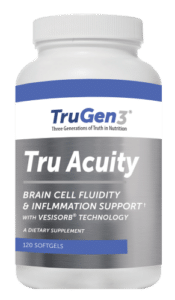
Tru Acuity is a patented formulation loaded with eight super antioxidants and powerful bioactives that support brain cell fluidity and the body’s natural inflammatory responses.

References:
- DiSabato DJ, Quan N, Godbout JP. Neuroinflammation: the devil is in the details. J Neurochem. 2016;139 Suppl 2(Suppl 2):136-153.
- Zhang W, Xiao D, Mao Q, Xia H. Role of neuroinflammation in neurodegeneration development. Signal Transduct Target Ther. 2023;8(1):267.
- Kinney JW, Bemiller SM, Murtishaw AS, Leisgang AM, Salazar AM, Lamb BT. Inflammation as a central mechanism in Alzheimer’s disease. Alzheimers Dement (N Y). 2018;4:575-590.
- McGeer PL, Itagaki S, Tago H, McGeer EG. Reactive microglia in patients with senile dementia of the Alzheimer type are positive for the histocompatibility glycoprotein HLA-DR. Neurosci Lett. 1987;79(1-2):195-200.
- Colonna M, Butovsky O. Microglia Function in the Central Nervous System During Health and Neurodegeneration. Annu Rev Immunol. 2017;35:441-468.
- Es-Sai B, Wahnou H, Benayad S, et al. Gamma-Tocopherol: A Comprehensive Review of Its Antioxidant, Anti-Inflammatory, and Anticancer Properties. Molecules. 2025;30(3).
- Pahrudin Arrozi A, Shukri SNS, Wan Ngah WZ, et al. Comparative Effects of Alpha- and Gamma-Tocopherol on Mitochondrial Functions in Alzheimer’s Disease In Vitro Model. Sci Rep. 2020;10(1):8962.
- Ahsan H, Ahad A, Iqbal J, Siddiqui WA. Pharmacological potential of tocotrienols: a review. Nutr Metab (Lond). 2014;11(1):52.
- Businaro R, Vauzour D, Sarris J, et al. Therapeutic Opportunities for Food Supplements in Neurodegenerative Disease and Depression. Front Nutr. 2021;8:669846.
- Hashimoto M, Hossain S, Al Mamun A, Matsuzaki K, Arai H. Docosahexaenoic acid: one molecule diverse functions. Crit Rev Biotechnol. 2017;37(5):579-597.
- Zinkow A, Grodzicki W, Czerwińska M, Dziendzikowska K. Molecular Mechanisms Linking Omega-3 Fatty Acids and the Gut-Brain Axis. Molecules. 2024;30(1).
- Satizabal CL, Himali JJ, Beiser AS, et al. Association of Red Blood Cell Omega-3 Fatty Acids With MRI Markers and Cognitive Function in Midlife: The Framingham Heart Study. Neurology. 2022;99(23):e2572-e2582.
- Li M, Li T, Yang T, et al. Cognitive Benefits of Folic Acid, Docosahexaenoic Acid, and a Combination of Both Nutrients in Mild Cognitive Impairment: Possible Alterations through Mitochondrial Function and DNA Damage. Gerontology. 2024;70(9):940-949.
- Kehinde SA, Lin WP, Lay BB, et al. Curcumin and Dementia: A Systematic Review of Its Effects on Oxidative Stress and Cognitive Outcomes in Animal Models. Int J Mol Sci. 2025;26(14).
- Li G, Wu Q, Wang C, et al. Curcumin reverses cognitive deficits through promoting neurogenesis and synapse plasticity via the upregulation of PSD95 and BDNF in mice. Sci Rep. 2025;15(1):1135.
- Francis AJ, Sreenivasan C, Parikh A, et al. Curcumin and Cognitive Function: A Systematic Review of the Effects of Curcumin on Adults With and Without Neurocognitive Disorders. Cureus. 2024;16(8):e67706.
- Dos Santos MG, Arbo BD, Hort MA. Effects of quercetin and its derivatives in in vivo models of neuroinflammation: A systematic review and meta-analysis. Neural Regen Res. 2026;21(5):1783-1792.
- Azmal M, Paul JK, Shohan MNH, et al. Evaluating computational and experimental approaches in early-stage Alzheimer’s drug discovery: a systematic review. J Comput Aided Mol Des. 2025;39(1):27.
- Yang Y, Zhang Y, Chen L, Li Z, Zhao Q. Therapeutic potential of quercetin in depressive symptoms: a systematic review and meta-analysis of preclinical studies. Front Pharmacol. 2025;16:1598053.
- Hartmann T, van Wijk N, Wurtman RJ, et al. A nutritional approach to ameliorate altered phospholipid metabolism in Alzheimer’s disease. J Alzheimers Dis. 2014;41(3):715-717.
- Glade MJ, Smith K. Phosphatidylserine and the human brain. Nutrition. 2015;31(6):781-786.


